Theme 2: Abstract
Variable Long-term Performance of Released Sandfish
Steven Purcell and Matéo Simutoga
The WorldFish Center, c/o Secretariat of the Pacific Community
B.P. D5, 98848 Noumea Cedex, New Caledonia
s.purcell@cgiar.org
 Downloadable Abstract
The sandfish Holothuria scabra is a valuable, overfished sea cucumber, considered suitable for restocking and stock enhancement. Although better management can undoubtedly help replenish some sandfish stocks, breeding populations at many localities are now too depleted to enable natural recovery. At such places, the major need is to create and protect effective spawning populations through restocking. Elsewhere, stock enhancement may be appropriate to overcome recruitment limitation.
A 4-year project based in New Caledonia has evaluated optimal methods for releasing hatchery-produced sandfish in the wild to provide the technology for restocking and stock enhancement programs. The genetic structure of sandfish populations was determined to identify how cultured juveniles can be released responsibly. Hatchery-based experiments have produced methods for scaling-up production of juveniles, transporting juveniles from the hatchery to release sites, and marking juveniles to distinguish them from wild individuals. Scaling-up production was achieved through rearing newly-settled juveniles in mesh enclosures in earthen ponds. Immersion-marking of small juveniles, in solutions of either tetracycline or calcein, stained dermal spicules and proved a cheap, simple and long-lasting method for identifying released sandfish. A standardized disease check was also developed and applied before releases of juveniles.
Field experiments, involving controlled releases of juveniles in open (1 m2) sea pens, were used to identify the best micro-habitats, juvenile size and time-of-day for releases. The seagrass-mangrove habitat was considered the most suitable for releasing juvenile sandfish, but replicated releases in varying microhabitats were needed to identify the biotic and abiotic features that optimized survival and growth. An initial size-at-release experiment showed that juveniles <1 g were too small to be transferred to the wild. The effect of time-of-day on survival was less important than release habitat or juvenile size.
The optimal release methods were then applied in a larger-scale release experiment, which is the focus of this paper. Four thousand hatchery-produced juveniles were immersion-marked. We marked juveniles of 1-3 g with tetracycline, those 3-8 g with calcein, and those 8-20 g with both fluorochromes sequentially. Two thousand juveniles were released into an open 500-m2 sea pen in a shallow seagrass meadow at each of two sites, Nepoui and Ouano. Sandfish were recaptured from randomized quadrats (n = 28) after 1, 2, 4, 6, 12, and 18 months and counted and measured. A small dermis sample (2-5 mm2) was taken from each recaptured animal, then processed and examined using epifluorescence microscopy to attribute individuals to their original size classes.
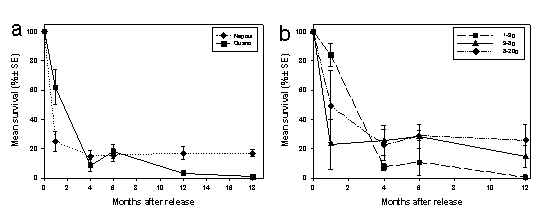
A great proportion of the mortality of released sandfish was in the first few months (Fig. 1a). Survival was initially similar between the two sites but fell markedly at Ouano after 6 months. In contrast, survival at Nepoui was relatively high (17% ± 2% SE) 18 months after release. Mortality was significantly higher for juveniles of the smallest release size (Fig 1b).
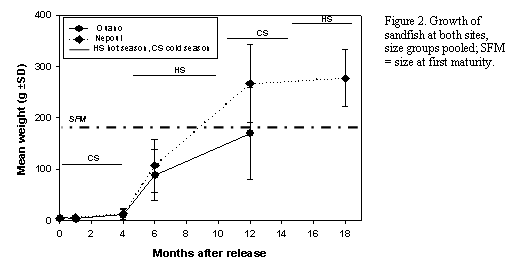
Growth was also highest at Nepoui, where most sandfish reached the size at first maturity in 12 months and mean size was 277 g (± 54 g SD) at 18 months (Figure 2). Temporal variation in growth rates appeared to be related to water temperature.
Spatial disparity in the survival of sandfish suggests that multiple release sites are needed to mitigate occasional failures. The study suggests that sandfish should be released at sizes >3 g to optimize survival. Restocking programs should expect larval production from released sandfish no sooner than 1-1.5 years after release. In cases where releases are intended for stock enhancement, we estimate that released sandfish would take, on average, 2.4-3.7 years to reach market size of 500 g.
We also compare the costs for producing sandfish in several countries and examine cost:benefit ratios for restocking and stock enhancement. Not surprisingly, the costs of restocking, and feasibility of stock enhancement, vary widely among countries. The benefits of releasing sandfish should be weighed against the likely returns, and restocking and stock enhancement of sandfish should add value to other management tools.

 Call For Papers